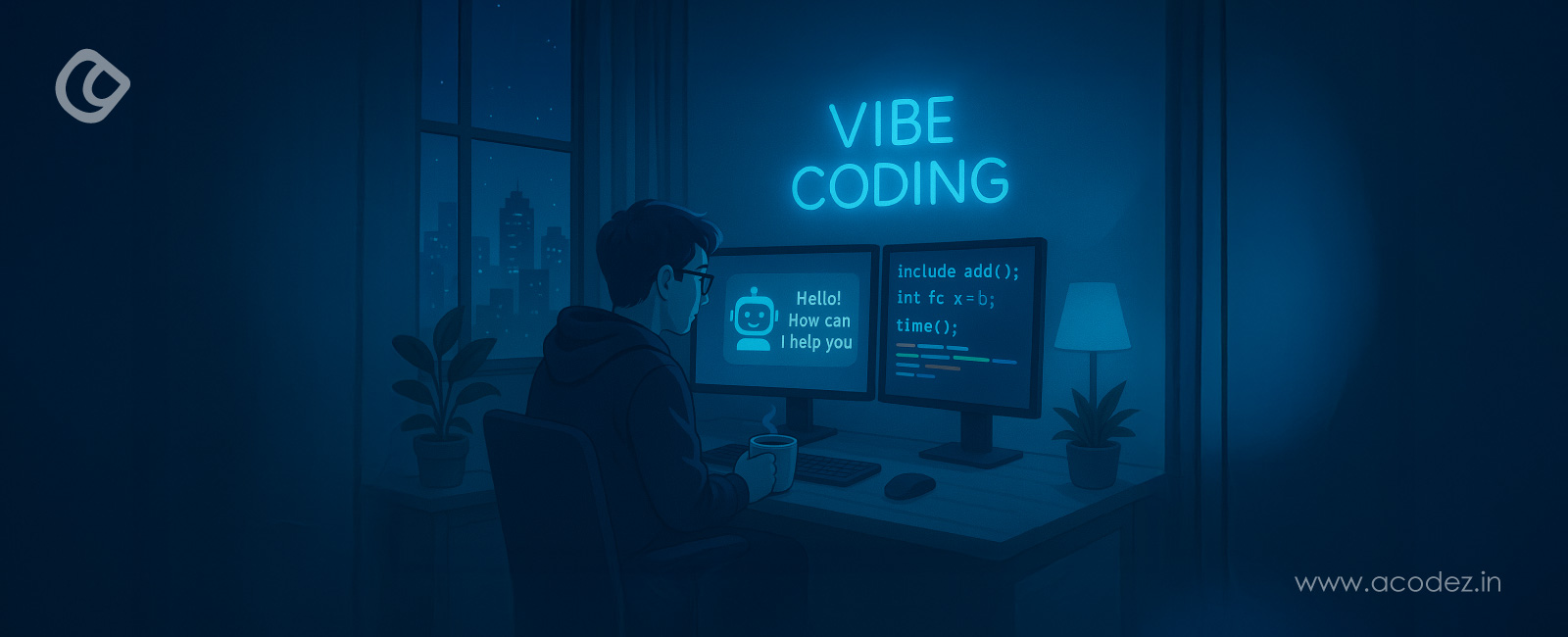
What Is VIBE Programming, Really?
VIBE isn't an official acronym yet, though you'll see people expanding it in a dozen ways. For our purposes, it's Voice or Intent-Based Engineering — a style of programming where you describe your goals in natural language, and an AI assistant generates, modifies, or explains the code that meets those goals.
It's not about replacing developers; it's about offloading the tedium. You stop micromanaging the syntax and start managing the outcome. 84% of developers are already using or planning to use AI tools in their development process in 2025, reflecting how deeply this shift is taking hold.
Instead of typing traditional for loops and conditionals, you might describe what you want in plain language: "Filter all tasks that aren't done yet and display them sorted by date." Your AI partner — ChatGPT, Cursor, or Copilot — writes it in the style and framework you prefer.
A Developer's Quiet Revolution
Most of us didn't sign up to babysit syntax trees. We just wanted to build things. VIBE programming is about reclaiming that vision. When AI entered our editors, it didn't replace us; it changed our job description. We're no longer coders in the strict sense; we're system designers with better autocomplete.
It's like pair programming, except your partner never gets tired and occasionally hallucinates entire frameworks that don't exist. AI is weak in certain areas: naming variables, understanding business rules, and remembering context across sessions. But it's excellent at boilerplate, pattern matching, and generating boring code we'd rather not write. Developers complete tasks 55% faster when using AI coding assistants. That's the essence of the VIBE mindset: you focus on the what, and let the AI handle the how.
Tools of the Trade: Who You're Actually Talking To
Let's clear something up: when we say "talk to your AI," we're not just speaking metaphorically. You're probably talking to ChatGPT, Cursor, GitHub Copilot, Replit Ghostwriter, or one of the open-source alternatives like Codeium or OpenDevin.
ChatGPT is the generalist. It's the dev who's read everything, answers quickly, and occasionally overconfidently cites nonexistent Stack Overflow threads. It's best for exploring design ideas, refactoring logic, and writing helper scripts outside your main IDE.
GitHub Copilot is the quiet one who finishes your sentences. It's embedded right into your editor, perfect for inline completions and small code blocks. It doesn't need long conversations — it just needs context.
Cursor takes things further. It's basically VS Code crossed with ChatGPT. You can highlight a file, type /fix or /explain, and have an AI that knows your entire repo make changes intelligently. It's ideal if you want to stay in one place and treat the AI as your code editor's new brain.
Replit Ghostwriter is the minimalist, built for fast prototyping and web projects. It's great when you want to vibe code something simple directly in the browser.
VIBE in Action: Building a Task Tracker
Let's make this real. Suppose you're building yet another Task Tracker — because every developer's first app was, and somehow still is, a to-do list. You open your editor, and instead of typing boilerplate, you start describing what you want: "Create a simple task tracker in JavaScript ES6 that lets me add, mark, and remove tasks. Store them in localStorage so they persist after refresh."
That's it. No framework. No setup wizard. Your AI buddy responds with working code that implements the requested functionality, complete with methods for adding, toggling, removing, and persisting tasks. In five seconds, you've got a working prototype. Is it production-ready? No. But it's enough to start thinking about logic, UI flow, and edge cases — the parts that actually matter.
Debugging the AI (and Yourself)
Working this way changes your habits. You're no longer fighting the compiler; you're negotiating with a model. Sometimes you'll find yourself rephrasing a prompt five times before it clicks. That's not a bug; that's the new kind of debugging. Instead of stepping through stack traces, you step through intent. Did I tell it what I meant or what I wanted to see? Did I give it the right context? Did I specify the environment or language version?
The Art of Prompting Without Losing Your Sanity
If you're new to AI-assisted coding, the first temptation is to treat the assistant like a search engine. Don't. It's more like a junior dev who never sleeps but occasionally makes wild assumptions.
- Be explicit. "Write a React hook for fetching data from an API" is better than "Help me with data fetching."
- Iterate in small steps. Ask it to add a feature or fix a bug, not rewrite your whole repo.
- Keep a prompt log. When something works, save the phrasing. It's your new cheat sheet.
- Review everything. AI doesn't make mistakes — it makes confident guesses. You're still the adult in the room.
Why Companies Resist (and Why They'll Come Around)
Some companies ban ChatGPT and its friends outright, sometimes for data privacy reasons or out of concern that AI-generated code may leak secrets or cause licensing issues. Those are valid concerns. But so was the internet, and we worked that out too. The real risk isn't that developers use AI — it's that they fall behind because they don't. In a few years, VIBE programming will be as normal as using Git or Stack Overflow. Not because it's flashy, but because it saves time.
The VIBE Mindset
VIBE programming isn't about giving up control; it's about redefining it. It's like shifting from driving a stick shift to using adaptive cruise control: you're still steering, but you're not fighting the gears anymore. You still review, refactor, and reason about code, but you let the machine take care of the typing.
The Future: Less Typing, More Thinking
VIBE programming doesn't eliminate coding; it just changes where the effort goes. The hardest part isn't writing functions; it's explaining what you want clearly enough that a machine can understand you. When you offload boilerplate, you make space for real work — the kind that used to get buried under tickets. Instead of manually stitching CRUD logic, you can think about architecture, user experience, or why the system even exists.
The Compiler Is Now a Conversation
There's an old saying: "Code is what you write when you can't express what you want." That's truer than ever. Your new compiler isn't a parser — it's a dialogue. You don't run it; you negotiate with it. The more clearly you can describe intent, the more precise the output. If that sounds like soft skills invading hard science, well — yes. That's the point.
The Return of the Architect Mindset
Ironically, VIBE programming might take us back to the roots of computer science, when developers were architects, not factory workers. Before frameworks and pipelines, programming was about design thinking: modeling the world, simplifying chaos, building elegant abstractions. When an AI can scaffold a prototype in seconds, you get to ask bigger questions again: Should this exist? What's the best user flow? What trade-offs are we making?
You become less of a code monkey and more of a system composer. Someone who directs the orchestra rather than tuning every instrument.
Coding as Thought Amplification
If you zoom out, VIBE programming isn't really about code at all. It's about thought amplification. Every generation of tooling — compilers, IDEs, frameworks, CI/CD — was an attempt to shrink the gap between what we imagine and what the machine understands. AI is just the latest bridge. But it's also the first bridge that talks back.
Where Does That Leave Us?
Probably right where we started, trying to make sense of a tool that's both powerful and unpredictable. The difference now is that the barrier between thought and execution is thinner than it's ever been. You don't have to wait for a sprint cycle or a green light to try an idea. You can describe it, test it, and iterate before lunch. That's the real promise of VIBE programming: creative momentum.